Add To Wishlist
Product


The sun had barely risen when little Meera ran across her grandmother’s courtyard, the cool earth still damp with dew. In the distance, she could hear the soft lowing of cows, the clink of metal pails, and the gentle swish of tails brushing away the morning flies. It was the sound of a village waking up — unhurried, honest, alive.
Every morning, Meera watched her grandmother, Aaji, begin the same ritual.
Fresh milk, still warm from the cow named Gauri, was poured into a wide steel vessel. Aaji always smiled and said,
“Good milk only comes from a happy cow,”
and Gauri, with her calm eyes and jangling bell, certainly seemed happy.
By noon, the milk had cooled and thickened into curd. Aaji would lift the lid and that soft, tangy aroma would fill the room — the smell of fermentation, of life, of nature doing its quiet work. “Curd first, then ghee,” she always said. “That’s how your great-grandmother made it, and her mother before her.”
This was the Bilona method, though no one in the house ever used fancy words like that. For them, it was simply the right way.
Meera loved the next part most — the hand-churning. The wooden bilona, shaped by years of use, sat in a tall clay pot. Aaji wrapped her soft cotton saree, sat down, and began turning the rope-wrapped handle.
Slow. Steady. Rhythmic.
Creek-creek. Creek-creek.
The sound echoed across the courtyard like a slow heartbeat.
As the curd thickened and separated, small white globules of butter began floating to the surface. Meera clapped her hands every time one appeared. Aaji winked, “See? Butter only listens when you churn with patience. Machines don’t understand that.”
And she was right. This gentle, manual churning is what gives Bilona ghee its unique nutritional strength — the butyric acid that heals the gut, the healthy fatty acids, the natural compounds our bodies recognize instantly. No machinery can replicate that softness, that bioactive richness.
When enough butter had collected, Aaji placed it in a heavy brass pot and set it on a small, controlled flame. No rushing. No high heat. Just a quiet simmer.
Hours passed.
The butter slowly transformed into something magical — golden, aromatic, shimmering like sunlight in liquid form. The house filled with that unmistakable nutty fragrance, the kind that wraps itself around you like a warm shawl. This slow cooking preserved the delicate vitamins — A, D, E, K — the ones today’s high-heat commercial ghee often loses in minutes.
Finally, Aaji strained the ghee, poured it into a jar, and handed the first spoonful to Meera. The texture was slightly grainy — danedaar, just as it should be — and the taste was rich, comforting, deeply familiar.
“This,” Aaji said, “is real ghee. Not the fast-made kind you see in shops. This one has life in it.”
And that was true.
Regular ghee, made from cream and high-speed machines, may be efficient — but it misses the stories, the science, and the soul. It skips fermentation, loses nutrients in high heat, and forgets the patience that makes ghee truly nourishing.
Bilona ghee costs more because it asks for more — more milk, more human hands, more time, more care. But what it gives back is something precious: purity, digestibility, richness, and a connection to the land.
In a world obsessed with speed, Aaji’s bilona pot sits like a quiet reminder:
Some foods deserve to be made slowly.
Some flavors deserve time.
Some traditions deserve to be carried forward.Bilona ghee isn’t just something you add to your food.
It’s something you add to your life — a return to mindful eating, deep nourishment, and the gentle wisdom of generations.
The sun had barely risen when little Meera ran across…
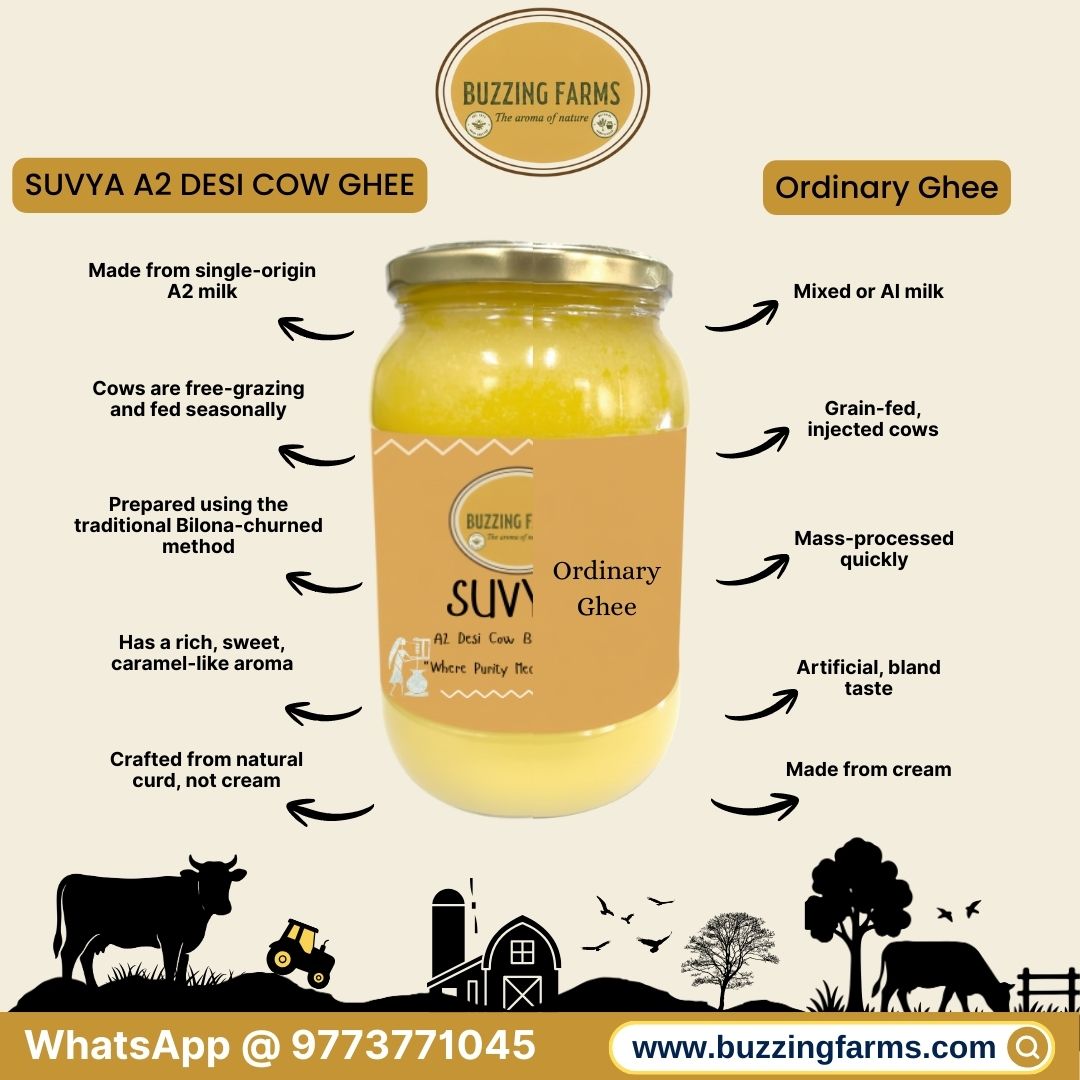
Feature Buzzing Farms A2 Bilona Ghee Regular / Commercial Ghee…
Leave a Reply